 HW Legal
We Are Separating / Getting Divorced. What About Child Support?
When a relationship or marriage comes to an end, parents often need to address several key issues: who will have custody of the children, how contact with the other parent will be arranged and how frequently it will take place, and how much child support will be paid.
Child support and the obligation to pay it are among the most common sources of disputes between former partners and spouses. But how can the appropriate amount of child support be determined?
At the end of 2022, the Czech Ministry of Justice published new guidelines for determining child support for children whose parents do not raise them together. These guidelines are a more sophisticated replacement for the simpler child support table introduced in 2010. Although the guidelines are not legally binding, they are commonly used by courts and by parents negotiating out-of-court agreements.
As a general rule, a parent has a maintenance obligation towards a child who is not yet capable of supporting themselves. The parent who is required to pay child support is referred to below as the obligated parent. But how is the amount of child support determined?
The two principal factors are:
- the child's standard of living should, as a rule, be comparable to that of their parents; and
- the child's reasonable needs.
The first factor takes precedence over the second and is therefore considered more important.
However, the Ministry's guidelines do not take into account many recurring circumstances, nor various specific circumstances that may arise in individual cases.
Examples of common factors not reflected in the guidelines include:
- the parent's overall financial and property situation;
- the child's place of residence; and
- the possibility for adult children who are still studying to earn their own income.
Examples of specific circumstances not reflected in the guidelines include:
- increased expenses associated with children who have special needs (for example, children with disabilities);
- situations where the obligated parent voluntarily gives up a better-paying job without a valid reason;
- cases involving a larger number of dependants (the guidelines assume a maximum of four children); and
- obligated parents with exceptionally high incomes.
How Is Child Support Calculated?
Child Support Is Based on the Obligated Parent’s Net Income
Child support is calculated on the basis of the obligated parent's net income. For employees, income is reduced by personal income tax and mandatory social security and health insurance contributions. However, overtime pay, bonuses, performance-related compensation and similar payments remain included in the calculation.
For self-employed individuals, the calculation is based on the tax return, from which the parent's average monthly net income is determined, at least on an approximate basis. Courts will typically request salary slips for the previous 12 months or the most recent tax return.
The calculation also takes into account social benefits and other state benefits received by the parent, rental income, and various other sources of income.
The Child's Stage of Life Matters
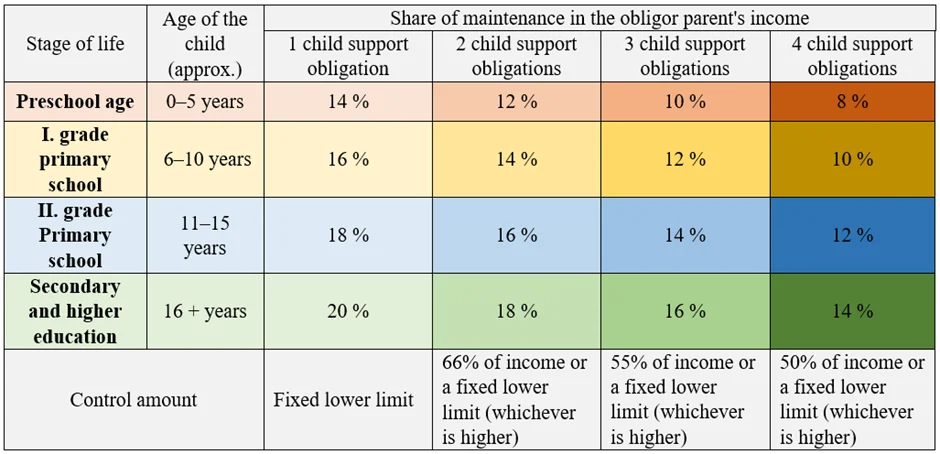
The Ministry's guidelines divide children into four life stages:
- Preschool age (0–5 years);
- Primary school – first stage (6–10 years);
- Primary school – second stage (11–15 years);
- Secondary school and higher education (16 years and older).
These age ranges are merely indicative. In practice, the child's educational stage is considered a more accurate indicator of their needs.
The Number of Dependants Is Also Taken Into Account
If the obligated parent has a maintenance obligation towards multiple children, the guidelines reflect this. Different percentage ranges are assigned to each life stage depending on the number of maintenance obligations the parent has.
For example, a two-year-old only child would generally be entitled to child support amounting to 14% of the obligated parent's income. If that child had three additional young siblings for whom the parent was also financially responsible, the applicable percentage would be reduced to 8%.
The Extent of Care and Contact Is Also Considered
In practice, it is common for the obligated parent to cover many of the child's ordinary expenses directly—for example, paying nursery or school meal fees, purchasing clothing, funding extracurricular activities, and spending substantial time with the child, even though the child is not primarily in that parent's care.
Should such a parent pay the same amount of child support as a parent who provides none of these contributions? The current guidelines attempt to address this issue.
The calculation considers the number of days per month that the child spends with the obligated parent, focusing primarily on full days including overnight stays.
(Number of days per month spent with the obligated parent) ÷ 30.4 = care ratio
(1 − care ratio) × (preliminary child support amount) = adjusted child support amount
However, where the number of days spent with the parent does not accurately reflect the extent to which that parent contributes to the child's ordinary needs, the court will assess the situation individually.
The Control Amount
If the calculated child support amount (or the combined amount payable for all children) would leave the obligated parent with an unreasonably low standard of living, the amount may be adjusted.
For this reason, a minimum amount that should remain available to the obligated parent is determined. Two calculation methods are used, and if they produce different results, the higher amount is applied.
The first method is based on a percentage of the parent's income depending on the number of maintenance obligations (for example, where the parent supports two children, the threshold is 66% of income).
The second method is a fixed minimum threshold calculated in the same manner as the protected income amount used when determining wage deductions in enforcement and insolvency proceedings. This amount can be determined using the Czech Insolvency Repayment Calculator. By selecting "0" children and "no" spouse and entering only the parent's net income, the resulting "net salary after deductions" represents the control amount.
The control amount is then deducted from the parent's net income, and the remainder represents the approximate maximum child support obligation.
If the calculated child support for one child would reduce the parent's remaining income below the control amount, the child support is reduced accordingly. Where multiple maintenance obligations exist, a proportional reduction method is used.
For indicative purposes, parents may use the child support calculator available on the Czech Ministry of Justice's website. However, the calculator does not account for many of the specific circumstances that a court may consider when determining child support.
When Is Child Support Increased?
Child support is typically increased when a child moves into the next life stage under the Ministry's guidelines.
In addition, where more than three years have passed since child support was last determined and the child remains within the same life stage, it is generally appropriate to increase the amount by an additional 1% of the obligated parent's income.
What About Parents with Exceptionally High Incomes?
There is not always a direct proportional relationship between a parent's income and the amount of child support.
According to the Czech Constitutional Court, child support may be considered excessively high if it enables the child to maintain a long-term or permanent lifestyle without working, even after completing their education and preparation for future employment. Such an outcome may be contrary to the child's best interests.
The Constitutional Court has also recognised that setting child support at an excessively high level may interfere with a parent's right to raise and educate their child.
Accordingly, the fact that an obligated parent is objectively capable of paying a certain amount of child support does not automatically mean that such an amount should be awarded.
Must Child Support Always Be Paid in Cash to the Other Parent or Directly to the Child?
No.
Part of the child support obligation may be fulfilled in other ways. For example, the obligated parent may contribute to a building savings account or another savings product established for the child, or may directly purchase certain goods or services for the child's benefit.
Why Do Parents Sometimes Transfer Child Support to Each Other? Can Child Support Claims Be Set Off?
In practice, situations sometimes arise where both parents transfer child support payments to each other.
This most commonly occurs in cases of shared custody, particularly where both parents enjoy a similar standard of living. Each parent alternates in caring for the child, and each may be ordered by the court to contribute to the child's maintenance, usually by paying child support to the other parent.
Why does the court not simply order one parent to pay only the difference between the two child support amounts?
The reason is that Czech law prohibits the set-off of child support claims belonging to a minor child who does not have full legal capacity. Consequently, courts cannot effectively "offset" mutual child support obligations.
This arrangement may nevertheless prove advantageous if one parent stops making payments. In such circumstances, the other parent may enforce the full amount of child support awarded by the court (for more information on what to do when a parent breaches obligations imposed by a court order regulating a child's arrangements, see our related article).
That said, if the parents reach an agreement regarding child support, they may in practice transfer only the difference between the respective amounts.
Need Advice on Child Support?
If you are currently dealing with child support issues with your child's other parent, we recommend seeking advice from an experienced family law attorney before taking any further steps.